

One of my earliest podcast memories from high school is of Sam Harris discussing the paradoxical path towards becoming a successful meditator. For those of you who haven’t tried Vipassana, or mindfulness meditation, the end goal is basically to quiet the mind: to be present in the purest sense of being present without latching onto thoughts or judgements. However, I usually find it is quite difficult to actually do this: even when I do manage to successfully clear the mind of thoughts about dinner or my crush in dance class, there’s still a part of me that’s judging how empty my mind is, preventing me from actually being fully in the present. In order to actually successfully meditate you have to cease being this reflective self. That self, as Sam Harris puts it, can’t get there from here.
While I still don’t fully understand how this works in terms of meditation1, I think this serves as a pretty apt metaphor for many other areas of life. We simply don’t understand how development, whether as an athlete, artist, or businessman is going to change our relationship to that craft, and who we are in that domain of life in general. In all these fields, the novice can never obtain mastery because in doing so he becomes a master and no longer thinks or behaves like a novice. He couldn’t get there from here.
There are three areas in my life, probably quite familiar to readers of this blog, where I very clearly see this process at work: running/triathlon, language learning, and science. I don’t pretend to be a master at any of these categories, but I do claim to have experienced a profound transformation in how I relate to my own process of improvement in each of them. There is no path from 12-year-old swimmer who pushed as hard as he could every practice, the grammar-drilling high-school student, and the flailing first-year graduate student to who I am today, but rather an abrupt disconnect– which paradoxically cannot be placed at a single point in time2. I’ll unpack what I mean more for each specific example below.
Endurance Sports
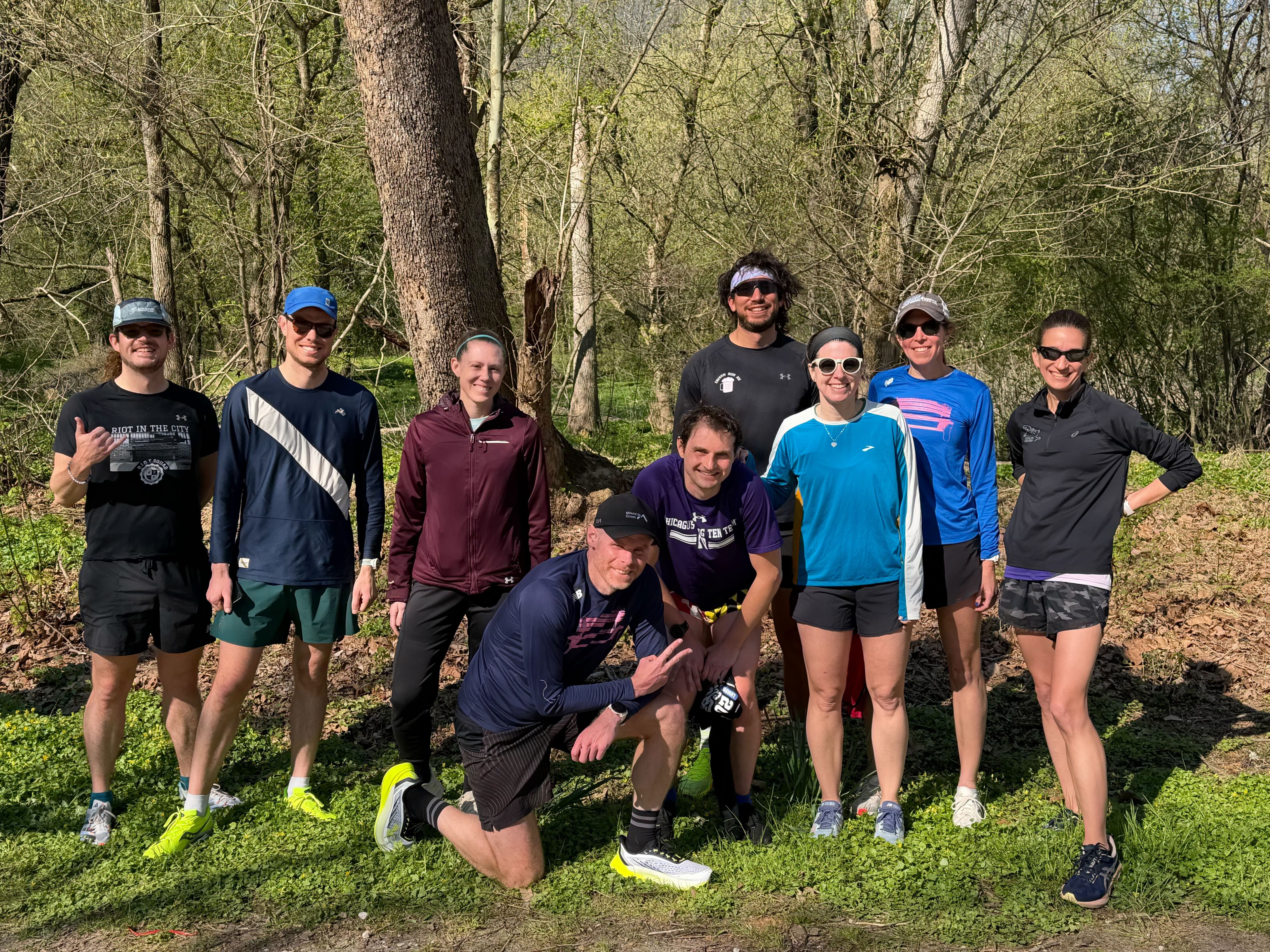
I started competitive swimming when I was in 4th grade around 9-10 years old. Before that, my parents had made me try a variety of different ball sports (soccer, basketball, baseball, tennis), as well as fencing. I was not particularly good at any of these: I was supremely uncoordinated (still am), not very fit, and because of the first two not very interested in improvement3. Swimming changed all that: I quickly became more coordinated, more fit, and much more interested in improvement, and I couldn’t tell you exactly why. Perhaps this first season of swim club represents the first “you can’t get there from here” moment: before I had no interest in sport despite parental pressure, and afterwards it became one of the pillars of my life. The Joshua that deliberately ran away from the ball in soccer games, couldn’t hit a single baseball, and walked during the elementary school run-a-thon would never have been able to understand the person I became within a few months.
The next phase of my endurance sports career was characterized by what I like to call a try-hard, or a no-pain-no gain attitude. I thought that if I just worked harder I would improve. I would constantly sprint the warm-up, race during dry-land circuits, and, once I switched my primary focus to running, treat every easy day as a tempo or light threshold. The model of how I saw myself improving was the ability to continually handle more and more pain and more and more work until I was some kind of athletic übermensch.
This phase lasted from when I was about 10 to my senior year cross country season when I was 18. Ending it required another shift in perspective. I wasn’t going to keep improving, and in fact, I was getting worse by continuing to bash my head into a wall of always high-intensity all the time. In my junior year, along with my friend Zack4, I began to become interested in how to actually train and improve based on the science. It wasn’t so much a question of grit and mental toughness and grinding really hard every day, but of intelligently putting together a mix of training that would support the physical and psychological adaptions necessary for improvements. The try-hard, whose favorite poem was Invictus5, and prided himself on how tired he was after practice, never could have gotten here from there.
I have changed my attitude towards training and endurance sports quite a bit since I was 18, but I don’t think I’ve had another discrete transformation. My realizations that lifestyle can have a larger impact than the training itself, the importance of adapting training to my individual genetics and physiology, and the importance of truly easy days all fit within this framework of training as recipe rather than a wall to be knocked down with a sledgehammer. I could get here from there.
Language Learning

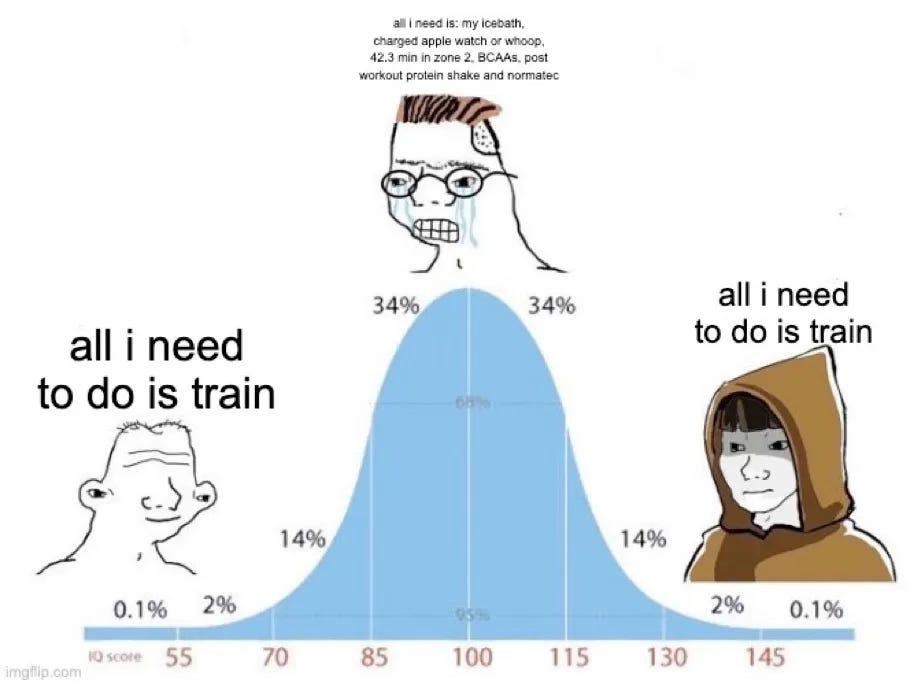
One of the big problems with most language learning instruction in schools and on apps like Duolingo, is the disconnect between how the language is taught and what kinds of activities you want to actually use the language to do. In my other blog posts I like to break up the latter into four different domains: reading, writing, listening, and speaking. Traditional classroom instruction, as well as the apps, heavily favor the output domains, probably due to the need to evaluate a student’s progress, which is much more difficult to do from the standpoint of pure input. This approach also heavily relies on translation from one’s native language. It’s a little absurd to expect that constant grammar drills, and speaking exercises that involve heavy amounts of translation from one’s native language to lead to fluency, which involves seamless and intuitive understanding of written and spoken language. You simply can’t get there from here.
I tried really hard to get there from here using traditional methods in various languages. 10 years of Spanish in elementary → high school. Not fluent. 3 years of an hour of Duolingo a day in Dutch. Not fluent. I made similar attempts, although with much less effort for Japanese, Hebrew, and French.
It was only with the discovery of Stephen Krashen’s input hypothesis, and a fundamental change in my approach to language learning away from book learning and towards acquisition that I was able to make real progress. Sixth grade Josh who thought drilling his conjugations harder would lead to fluency never would have made it here from there.
Science
In the career of every single scientist there is almost guaranteed to be a sharp “you can’t get there from here” moment. For me this happened during the second year of my PhD, where classes and controlled experiments gave way to the vast wilderness of the unknown that I would have to hack and slash through to arrive at my thesis. The skills that served me so well in class, memorization and logic, could only take me so far in this brave new world. The intimate details of your specific experiments and systems, how complex pathways interact with each other, and if your hypothesis is total bullshit or not are not facts that you can derive with a pencil and paper sitting with your advisor in July of 2021, but can only be won through the cauldron of trying things out and seeing what shit sticks. You can’t get there from here.
I blog about language learning, biology, the science and art of learning, and many other things. If you feel inclined, please subscribe or consider buying me a coffee.
Josh
How does one fully let go of the sense of self? I imagine it’s something like being a flow-state where there isn’t all this reflexive judging/checking in with one’s internal state: one simply is.
This is another aspect of meditation that Sam touches on in a lecture on gradual versus sudden realizations.
My dad coached my AYSO soccer team and I have vivid memories of him getting pissed off at me talking to my friend Riley about Pokemon while we were on defense instead of paying attention to the game.
Who is currently coaching me and remains the best coach I’ve ever had.
I DESPISE this poem now.
love the science photo choice, looking back at our past selves im reflecting on how i got from there --> here. as always, thanks for the insightful thoughts